


The high school and student movement this fall, revealing international realities and issues
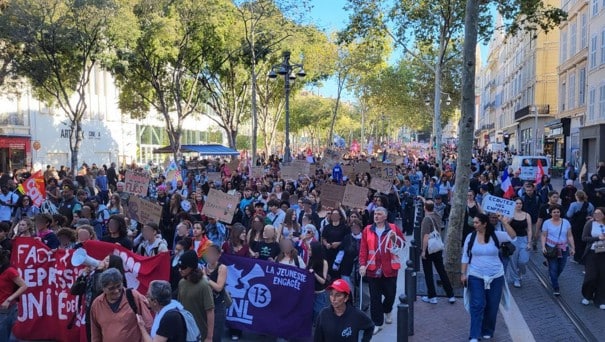
Originally focused on the lack of resources in high schools, the deterioration of teaching conditions, and the discretionary inevitability of Parcoursup, the ongoing movement actually highlights a budgetary policy that also seriously weakens and redirects university cooperation. But it also ignores a global issue: guidance, not as a system for assigning students to available spots, but as a skill—the ability to navigate choices—which needs to be developed in a world that is changing faster and faster, with jobs and types of employment that are emerging, evolving, and disappearing at an increasing speed.
From around 700,000 in 1968, the number of students in France exceeded 2,000,000 in the 1990s, reached 3,000,000 in 2024, and hit a record 3,074,600 in this 2026 school year. Funding has gone through a major shift, with a strong overall increase in spending, a drop in average spending per student, a relative decline in the State’s share (56% in 2024 compared to 76% in 2000), the rise of private education (about a quarter of students today, shifting costs to families or apprenticeships), and a significant increase in the share from companies (from 10% to 24%) through apprenticeships, which have developed more in master’s programs than in shorter professional tracks likely to host more students less geared toward academic success.
At the same time, a system was put in place to boost the value of university activities and push them towards financial independence under constraints, which led them to reduce their room for maneuver, look for their own funding, and gradually turn away from non-Western academic cooperation.
The removal of APL (lodging subvention for students) and the increase in university tuition fees for non-EU students, criticized by the current movement, stem from the same logic and follow the same trend.
Decided as early as 2019, the possible differentiation of tuition fees, except for doctorates, allowed universities the option not to apply it by granting exemptions, which they did extensively. This helped maintain the comparative advantage of French universities over Anglo-Saxon ones in terms of study costs, while forgoing a potentially significant source of revenue.
A decree from May 2026 heavily limited these exemption possibilities (and therefore forced universities to collect this own-source revenue) by capping them this year at 30% of the students concerned, 25% next year, and 20% in 2028/2029, compared to up to 70% before. So, it goes from €178 per year for a bachelor’s degree to €2,902, and from €255 to €3,950 for a master’s. Stricter rules are also set for exemptions decided by the institutions: academic excellence, verified socio-economic situation, inter-university partnerships, joint supervision. At the same time, through scholarships granted by embassies or the students’ home countries, this same decree aims to boost numbers in digital fields, artificial intelligence, quantum technology, biotechnology, as well as training for engineers and technicians—areas where France has significant needs that should be met locally rather than in the students’ home countries.
Beyond these financial contexts, high school critics also focus heavily on Parcoursup and are demanding its repeal, along with the opening of enough spots to meet all higher education applicants’ choices. Presented as a guidance tool, Parcoursup is really just an allocation/selection process—sure, sophisticated because it’s computerized and can handle many cases, but inevitably low in quality and very academic (grades above all…), overly focused on fit, and highly limited by the number of available spots, without any real opportunity to consider experience, extracurricular skills, pre-professional skills… nor, above all, any easing of the process, or integrating it into ongoing support that the 54 hours a year for high schools of guidance, established in 2018, could have allowed, if teachers were properly trained.
Yet the Future Plan, published in June 2025 to be implemented from the following school year, stated that “guidance is a skill that can be learned, just like any other,” and specifically included:
– a multi-year guidance education plan — PPO — in each school, developed with the support of the educational council and then adopted by the board of directors;
– a gradual programming from sixth grade to final year, across all educational tracks;
– four half-days each year, from fifth to final year, dedicated to discovering careers and training, organized during school hours;
– a connection with lessons, class meeting times, personal work, and professional immersions;
– gradual training of homeroom teachers.
It’s at the very least strange that this intention, more than a real plan with the necessary means, hasn’t been mentioned at all during the current mobilizations. It’s true that the need for immediacy and simplicity, driven by the shifting uncertainty of our world, works against the long, yet necessary, process described by this new text. So, it’s really about educational guidance, and using support methods that, at the same time, help young people find their way and teach them how to make decisions throughout their lives, in other words, how to grow into who they are.
These have been around for more than 50 years. Invented by Quebecers, they go beyond just providing information, which is inevitably perishable and often confusing, to make the experience, processing, and appreciation of personal experiences the heart of learning how to find your way, while acknowledging that uncertainty can certainly cause anxiety, but can also mean that opportunities are constantly multiplying and should be seized, without forbidding yourself from dreaming.
For this approach, orientation is not a moment in life. It’s a way of life. It’s an ongoing process. It’s not just about experiencing things by chance or necessity, it’s also about reflecting on them, trying to make them your own through systematic thinking, integrating them, and giving them meaning both as significance and as direction. It’s about learning to plan your life rather than necessarily having a set plan. It’s not just about choosing courses, a job, or even a career, it’s also about choosing a lifestyle, which now often includes the desire and/or need for change, becoming a normal aspiration rather than a sign of instability or imbalance.
And fortunately… since the world, its technical potential, and jobs are constantly changing and being reinvented more and more quickly, due to people’s actions, even when the typical job (full-time permanent employee, on-site, providing most of the person’s income, with an internal and long-lasting career within the employer) tends to no longer dominate, while these same people often themselves aspire to other forms of income-generating activities arranged differently with their other social roles, because of social advances (more time outside of work…) and technological (internet, remote work, transportation modes…) and cultural changes.
The rejection of adequationism is no longer a matter of principle, but of realism. It’s about learning how to become, a skill just as essential as any other, professional or behavioral, to navigate life continuously, in a world that is constantly changing and transforming faster than ever. A huge portion of the jobs and professions of tomorrow don’t even exist today and will be the unstable, evolving result of initiatives driven by people who might finally have been educated to make choices.
Paul Rousset, paulrousset46@gmail.com
USF AWB
