


African Diasporas and Inclusive and Sustainable Development
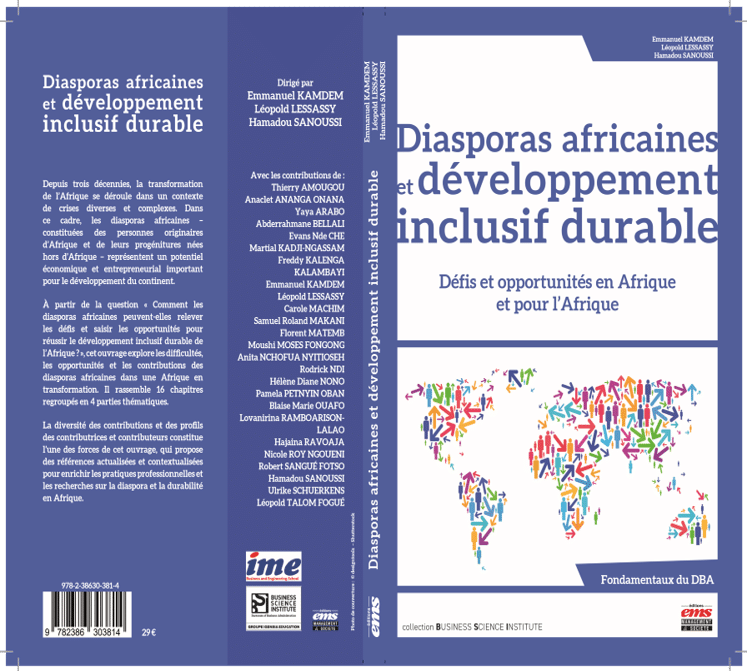
Kamdem, E., Lessassy, L., Sanoussi, H. (eds.) (2026). “African Diasporas and Inclusive and Sustainable Development: Challenges and Opportunities in Africa and for Africa.” Caen: Éditions Management & Société (EMS), Business Science Institute collection.
For several decades, Africa’s transformation has taken place in a context of complex and diverse crises, which can be understood by referring to the adjective ‘crísic,’ taken from Morin (1976, 2020), in his approach to theorizing crisis in relation to social complexity. In this line, Tooze (2022) explains the complementarity of crises (health, economic, political, generational, security, energy, environmental) through the lens of ‘polycrisis’: “We define a global polycrisis as any combination of three or more interacting systemic risks with the potential to cause a cascading, runaway failure of Earth’s natural and social systems that irreversibly and catastrophically degrades humanity’s prospects[1]. »
The timeliness and relevance of this concern justified the organization, by the Higher Institute of Management and Entrepreneurship (IME) of Douala (Cameroon), in collaboration with the Business Science Institute (Luxembourg and France), of the international colloquium on the theme: African diasporas, inclusive and sustainable development: challenges and opportunities in Africa (Douala, November 27-28, 2024). This work brings together the contributions to that colloquium. The 16 chapters are grouped into four parts focused on specific topics that provide an updated view on the difficulties, opportunities, and contributions of African diasporas in a transforming Africa. The crossed perspectives of the African academic in the diaspora (in the preface) and the African entrepreneur in the diaspora (in the afterword) are a big strength of this book, where people involved in projects about the diaspora and sustainability (in African contexts) will find ways to tackle the problems they face.
Also, this work returns to the fundamental issue of project financing in partnership in Africa; just like those initiated or carried out by the Association USF-AWB. A promising path was pointed out by the former president of the African Development Bank (AfDB), Akinwumi A. Adesina (2022), during the general assembly of this important African banking institution (Akinwumi A. Adesina, 2022): ‘The African diaspora has become the biggest financer of Africa! And this is not debt, it is gifts or donations 100%, a new form of concessional financing that is key to the livelihood security of millions of Africans (…) Since the flow of remittances to Africa is high, growing, and stable, it offers huge possibilities to serve as collateral and secure financing for African economies.’
African countries should securitize remittances to boost investments, especially in infrastructure on the continent.
Emmanuel KAMDEM
Professor Emeritus kamdemma@yahoo.fr / Site Web : www.kamdemma.com
[1] Source : https://adamtooze.com/2022/10/29/chartbook-165-polycrisis-thinking-on-the-tightrope/
USF AWB
