


And what if Trump cuts off the Internet? Consequences for Universities
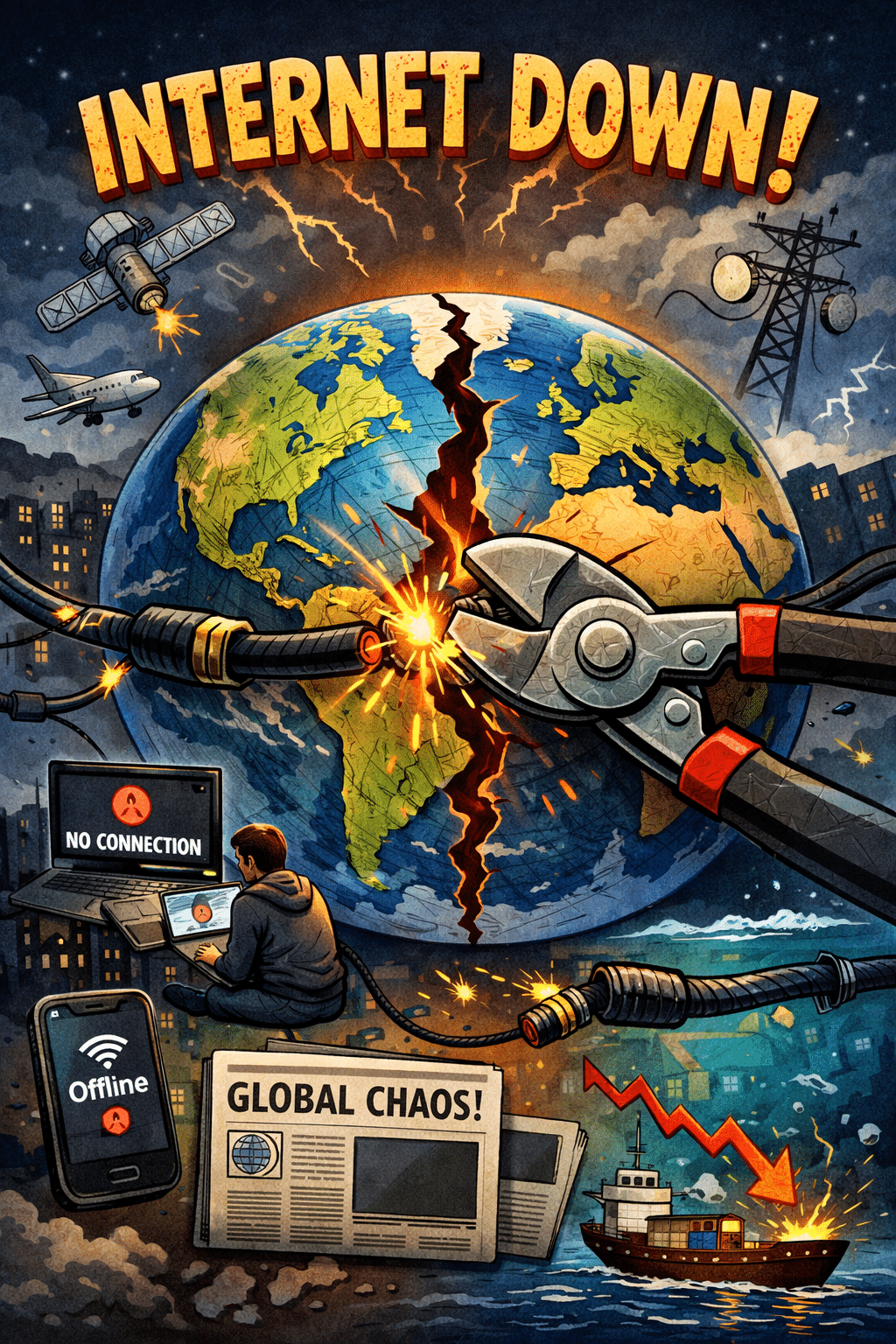
On several occasions, Trump has threatened to cut off the Internet. The consequences would be disastrous for the global economy, transportation, tourism, entertainment, etc. Remember that for every purchase made by credit card, an interconnection is established with a server across the Atlantic.
In reality, the Internet was designed as a network of networks, which means that there are multiple paths between two computers; this implies that a subnet can only be isolated for a short time, the time it takes for the routing tables to reconfigure. So, it’s one more “Trumpery,” but let’s imagine it were possible!
What would happen to universities if the Internet was completely cut off? No more international emails, no more access to international servers, no more video conferences, no more synchronous remote work with colleagues, no more access to international scientific resources, etc… Indeed, it would be a real change of academic civilization. It is not just a tool that would disappear, but the very infrastructure on which the production of knowledge, the circulation, and the validation of knowledge depends. Let’s quickly examine this disaster scenario without claiming to be exhaustive.
Teaching
Teaching would become essentially in-person again, because there would no longer be access to educational platforms (Moodle, Teams, ENT), no more online assignment submissions, no more video conference trainings, no more MOOCs, etc. Students would lose immediate access to information: no more access to search engines, no more Wikipedia, no more databases; learning would become slower (but perhaps more thoughtful?), more memorization-based, less assisted. Consequently, inequalities would widen: only students close to well-equipped libraries would be advantaged. Ultimately, this development would favor large universities at the expense of small ones or those with low budgets. One advantage would be the greater difficulty of plagiarism by copy/paste.
Campuses would become even more central places, university libraries would become sanctuaries of knowledge; exchanges between students and teachers would take on enormous importance, and universities would need to strengthen their physical infrastructures: classrooms, archives, documentation centers, and would need to return to paper circuits: handouts, printed bibliographies, announcements on bulletin boards.
Certainly, some computers could operate locally without any updates from Microsoft, Apple, Google, and even Ubuntu software, not to mention the countless artificial intelligence tools. One advantage would be paying less attention to the circulation of viruses. In short, increased local security.
Ultimately, universities will need to reinvent teaching methods, plan for investments, which would significantly change the economic model of universities. In other words, the removal of the Internet would lead to a return to teaching methods and ways of interacting with students similar to those practiced half a century ago, which could greatly slow down progress and educational innovation.
Research
It would be the near immobilization of global collaboration, because modern science relies on borderless exchange and sharing results almost instantly. Without a network, the researcher finds themselves isolated from their community.
Access to data: Most researchers store their data (for example: genetic sequencing, astrophysics, or sociology) on remote servers (the Cloud). Without a connection, access to these “raw materials” is cut off.
End of digital publications: access to publication platforms (end of open access and open science) would disappear; researchers would have to return to physical libraries to consult paper journals (if they are still preserved) and go back to paper mail for requests to authors for photocopies.
Reorganization of collaborations between researchers: this would be the end of constant exchanges by email and online meetings. As a result, there would be an increase in travel and physical meetings.
Reorganization of conferences: more hybrid conferences, both in-person and online, not forgetting the printing and sending of calls for papers and posters as well as physical meetings of reviewers. Consequently, we would see an increase in conference registration fees. On the other hand, conferences would once again become true opportunities for researchers to meet and to set up collaborations.
High-performance computing: researchers who use supercomputers remotely for complex simulations (climate, particle physics) would see their work halted.
How to cut off the Internet?
How to prepare for critical Internet access situations? In practice, cutting off the network of networks that is the Internet is impossible by design because the redundancy of paths is significant, even though what are called the “backbones” of major international networks are limited and could be targeted in the event of a major conflict.
See the map of international Internet fiber optics -> https://submarine-cable-map-2014.telegeography.com
Reactions
It should be noted that it is important to distinguish between shutting off Internet access only for American citizens and the global removal of the Internet. Cutting off the Internet only for American citizens seems like an option within Trump’s reach. By invoking state security, he would not be acting differently from the Chinese, Iranian, Russian governments, etc. But even in these countries, there is still a local internet. An exclusively American internet would allow American universities to reserve a significant share of global AI. But of course, with the complicity of American internet giants, he could then truly shut down the Internet for Americans.
The shutdown of the global Internet does not seem within Trump’s means, even if he can reduce the flows, and complicate exchanges with the rest of the world. But the question of sovereignty is raised in large regions of the world like Europe. Africa is more fragile with networks surrounding it. But in these times, it is good to consider all possible eventualities. You never know what tomorrow will bring!
In some respects, it would be a return to the functioning of universities as it was before the invention of the Internet. Research would become slower and more localized. It would be the end of open access electronic journals and a greater struggle for the acceptance of articles in paper journals. We would then witness a collapse of scientific productivity and a sharp decline in global knowledge production, with consequences for the economy and the creation of start-ups. For most countries, the minimum requirement would be to review their sovereignty in telecommunications and computing, and for each university or grande école to analyze the possible consequences and plan ‘Plan B’ solutions such as national service proxies that cannot be easily disrupted by a failure of the international network.
Fortunately, in the face of Trump’s threats, on the one hand it is technically very complicated and practically unfeasible, and on the other hand powerful economic interests would oppose such an approach; but this dystopian scenario shows that we really need to pay attention to digital sovereignty.
