


About the Szilard point and university funding.
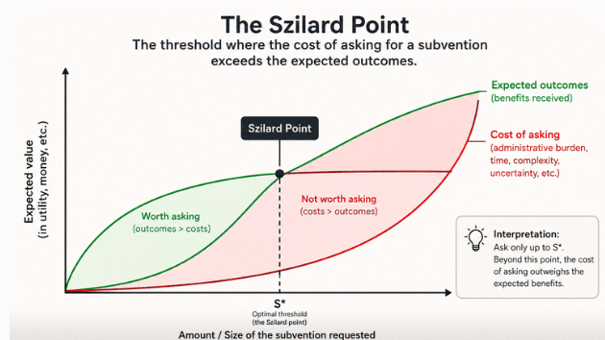
Originally, the Szilard point refers to a nuclear physics concept proposed by Leó Szilárd: it is the critical threshold at which a chain reaction becomes self-sustaining in a fissile material. The ‘Szilard point’ applied to funding has nothing to do with nuclear physics: it is a metaphor used in public economics and administrative sociology. It refers to the threshold at which a funding mechanism becomes self-sustaining, no longer because of its relevance, but due to bureaucratic logic, financial incentives, and structural effects.
In the context of grants, Szilard’s point is the moment when a program starts generating its own justifications, its own beneficiaries, and its own institutional support, making it very hard to stop, even if its actual effectiveness is questionable.
Ultimately, Szilard’s point refers to the critical threshold in scientific research funding systems where all the resources — like time, personnel, and administrative costs — spent on preparing, submitting, and competing for grants equal or exceed the total value of the grants awarded, leading to a net loss of productive scientific effort.
From Leo Szilard’s satirical short story, ‘The Mark Gable Foundation,’ in which a fictional philanthropic industrialist comes up with a grant mechanism explicitly designed to slow down scientific progress by diverting researchers’ time toward bureaucratic applications rather than discovery; the idea critiques hyper-competitive funding environments that favor proposal writing over experimentation. In contemporary analyses, it’s noted that empirical observations show diminishing returns in grant success rates—often below 10-20% at major agencies—where scientists report spending up to 20-40% of their time on applications.
The consequences are as follows:
1. Self-perpetuation of the programs. Once this threshold is crossed, the funded actors become dependent on the subsidy, they produce reports, evaluations, and projects that justify the continuation of funding, and administrations have an interest in keeping the program going to preserve their scope. The program becomes structural, even if its actual impact is small.
2. Institutional lock-in effect. Because subsidies create jobs, structures, networks of actors, and administrative habits, stopping the program becomes politically and socially costly.
3. Inflation of requests. Once the Szilard point is reached, beneficiaries keep producing more requests, administrations create new criteria, new procedures, new calls for projects, and the system becomes more complex and stronger.
4. Difficulty of evaluation. Programs become hard to audit objectively, protected by the stakeholders who depend on them, politically sensitive (jobs, territories, associations). Thus, the funding program continues even if the results are mediocre.
5. Risk of disconnect with real needs. Funding can end up supporting structures that exist just for getting grants, rather than projects that meet an actual social need. For example, you could mention the creation of agencies dedicated to grant applications, which charge hefty fees. There have even been cases in private companies of people in charge of “grant engineering,” whose role was to find grants that could help the company—basically, a very particular profit center!
As an example, let us quickly look at aid to American universities through student loans. The state-backed loan system encourages universities to raise their fees, creates student dependence on loans, and makes any structural reform extremely difficult. Thus, funding feeds cost increases, which in turn justifies the funding.
As we can see, poorly thought-out grant creation procedures generate vicious circles that are very hard to break out of.
So what?
In practice, each lab director needs to think carefully before writing or having someone write a research grant proposal, weighing the costs of writing against the expected return. For this reason, many lab directors have told us that they no longer submit such applications at the European level because the competition is too tough and the outcomes are uncertain.
As one can say, is it really worth it?
What can be done? Many universities ask USF to help them draft grant applications, and we are hesitant for three reasons: first, the time it takes to write them; second, the low success rate; and third, because the result is usually negative, which can lead to a loss of trust between the requesting university and USF.
