


Higher education in the age of AI
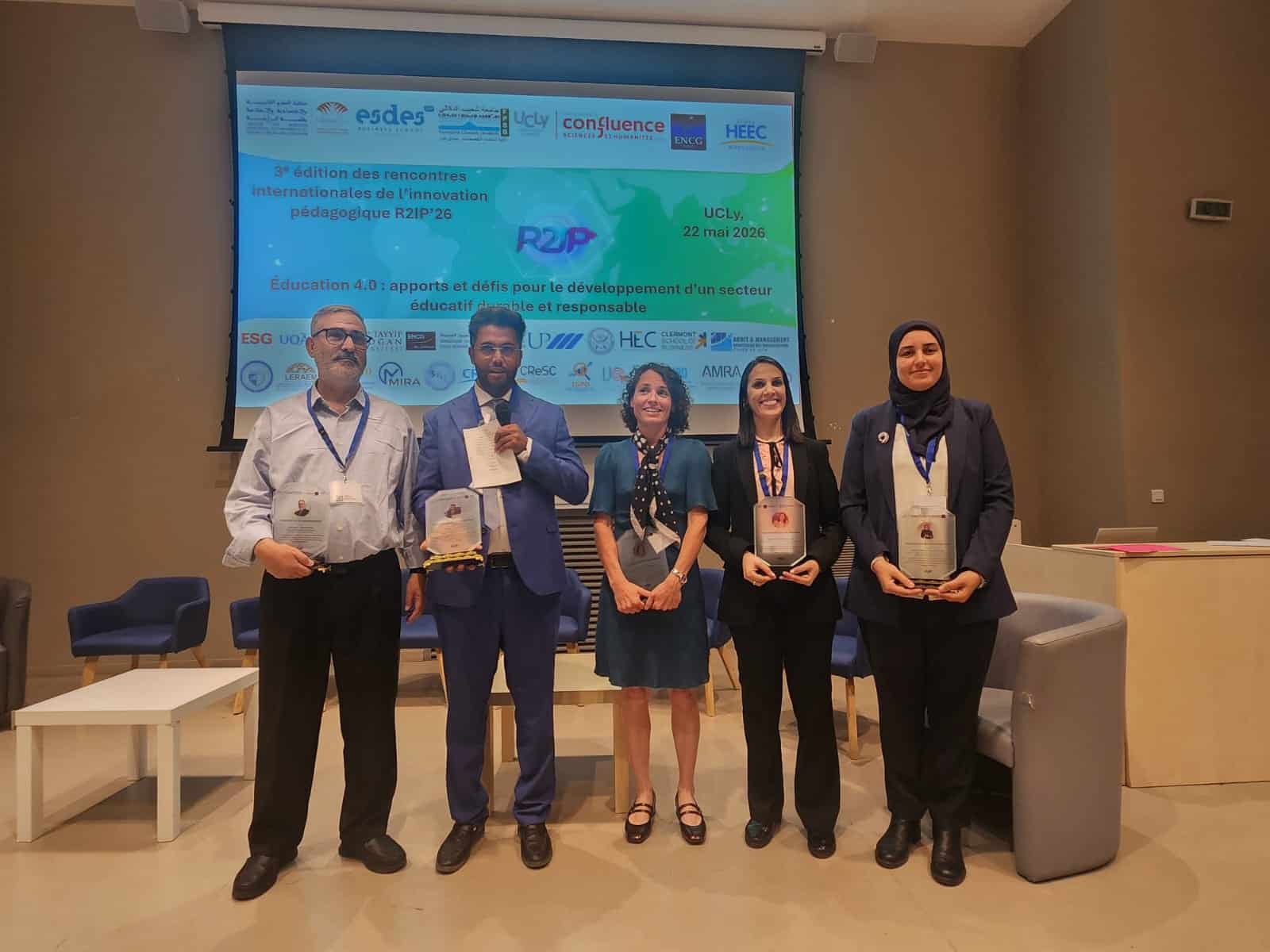
As AI tools are multiplying and everyday life is being transformed by their rapid spread, the academic community is stepping up to tackle the new questions our society is facing. To show this commitment, the 3rd edition of the International Meetings on Educational Innovation (R2IP) took place on 22 May 2026 at the Catholic University of Lyon, co-organized by the lab CONFLUENCE: Sciences and Humanities.
Designed like a real international academic research day, this event was led by five active professors in the field: Prof. Sylvaine MERCURI CHAPUIS (ESDES, UCLy – CONFLUENCE: Sciences and Humanities, France), Prof. Manal BENATIYA ANDALOUSSI (FPSB, Chouaib Doukkali University, Morocco), Prof. Jalila BOUANANI EL IDRISSI (ENCG Settat, Hassan I University, Morocco), Prof. Abdellah NOUIB (FSJES KS, Cadi Ayyad University, Morocco) and Prof. Abderrahim BEN BOUNA (HEEC Marrakech, Morocco). It brought together around sixty authors, speakers and presenters from six different nationalities (Morocco, France, Switzerland, Belgium, Canada, Turkey). Scientific communications, sharing experiences and discovering best practices, questions, the latest trends and technologies transforming teaching and learning, were all part of the event.
Twenty-seven studies were selected by the scientific council to be presented in parallel sessions around five main themes: integrating emerging technologies into teaching; innovative teaching models and adapting to students’ needs; learning analytics and personalizing the educational experience; professional development and supporting teachers in a digital context; and teaching and pedagogical practices in the age of artificial intelligence along with their ethical implications. Each topic received particular attention from the participants.
We can mention: an analysis of Morocco’s economic development through Internet use, literacy, investment and the labor market; the contributions of digital tools in personalizing learning, improving access to training, diversifying teaching methods and developing learners’ digital and transversal skills, looked at through factors that promote the effectiveness and inclusivity of educational systems; or even the analysis of conditions for ethical and responsible integration of AI in higher education and proposals for recommendations to support university policies on educational innovation.
The proceedings of this 3rd edition with all the studies will soon be available online and a special issue in an indexed journal featuring the best contributions is being prepared. The 4th edition will take place in May 2027.
Sylvaine Mercuri Chapuis <smercurichapuis@univ-catholyon.fr>
